 Mon – Fri: 8:30 AM – 5:30 PM
 3585 Stevens Creek Blvd, San Jose, CA 95117
 (408) 985-2000
 (408) 985-1000


 Make An Appointment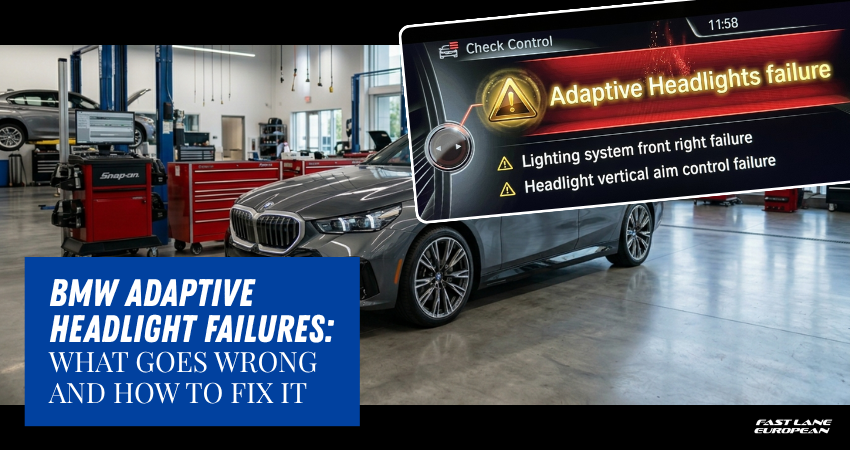
BMW’s Adaptive Headlight System is one of the more impressive pieces of safety technology on modern vehicles. As you steer through curves, the headlight units physically pivot to illuminate the road ahead of the turn rather than pointing straight ahead regardless of your direction of travel. The result is dramatically improved visibility in low-light conditions — particularly on the winding mountain roads around San Jose and the curves of Highway 17 toward Santa Cruz. When the system fails, though, it typically announces itself with a warning message on the iDrive screen and headlights that no longer pivot with steering input. At Fast Lane European, our technicians diagnose and repair BMW adaptive headlight faults regularly, and understanding what commonly fails helps owners make informed decisions about the repair.
How the BMW Adaptive Headlight System Works
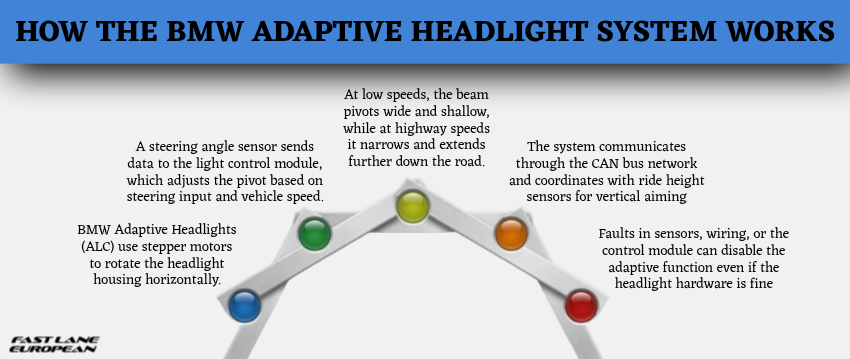
BMW’s implementation — sometimes labeled as the Adaptive Light Control (ALC) or Adaptive Headlights — uses stepper motors integrated into each headlight unit to physically rotate the headlight housing on a horizontal axis. A steering angle sensor sends data to the light control module, which calculates the appropriate pivot angle based on steering input and vehicle speed. At parking lot speeds, the system provides wide, shallow pivots. At highway speeds, the pivot narrows and extends the beam further down the intended path.
The system communicates over the vehicle’s CAN bus network, and the headlight control module coordinates with other systems including the ride height sensors (which also affect vertical headlight aim on vehicles with adaptive suspension). This network dependency means a fault in one area — a steering angle sensor error, a control module fault, or a wiring issue — can disable the entire adaptive function even if the headlight hardware itself is intact.
Common Failure Points
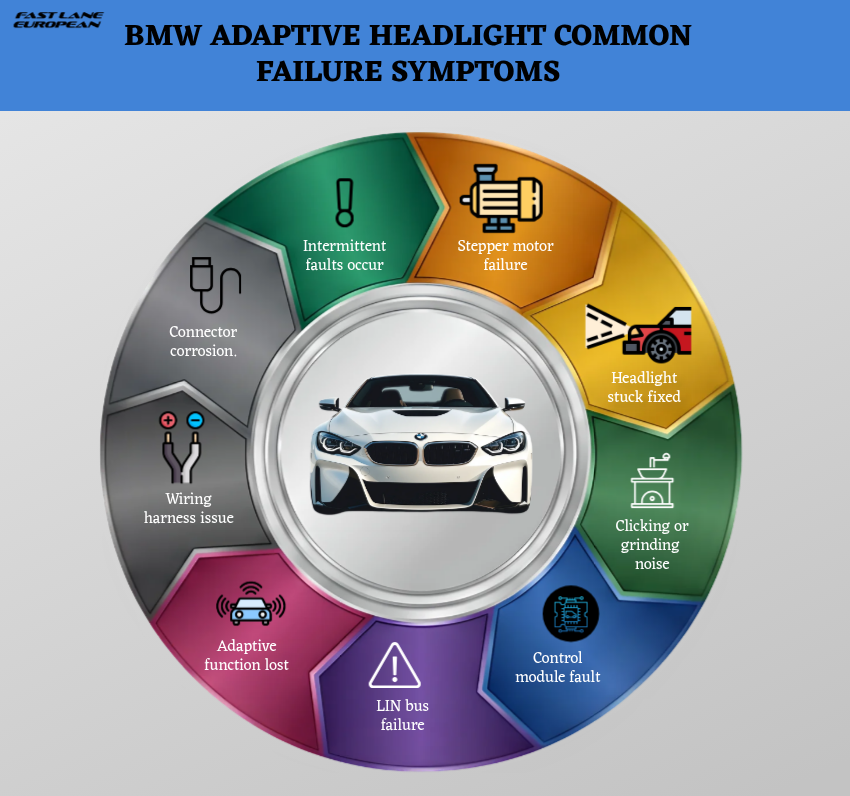
The most frequent hardware failure is the stepper motor inside the headlight unit. These small electric motors move the reflector housing on a precise track, and over time the motor’s plastic gears or internal windings degrade. A failed stepper motor produces a headlight that stays fixed regardless of steering input, and often generates a clicking or grinding noise from inside the headlight unit as the motor attempts to drive a mechanism it can no longer move.
The headlight control module is the second most common failure. This module processes the steering and speed data and sends commands to the stepper motors. When the module fails or develops communication faults on the LIN bus (which connects the module to each headlight unit), adaptive function is lost. Diagnostic trouble codes related to the adaptive headlight module or headlight bus communication errors confirm this failure path.
Wiring harness issues are also a contributing factor on higher-mileage BMWs. The wiring that connects the headlight assembly to the vehicle harness is subject to flexing each time the headlight pivots, and the connectors that interface with the stepper motor can corrode or develop intermittent continuity. This produces adaptive headlight faults that come and go with temperature or moisture rather than failing consistently.
What the Warning Message Means
The iDrive message “Adaptive Headlights: Function Unavailable” or the headlight warning indicator does not necessarily mean the entire headlight needs replacement. The warning is triggered by any fault in the adaptive system — motor, module, wiring, or a calibration fault after a headlight has been serviced. Before assuming you need a complete headlight assembly replacement (which on some BMW models runs over $1,000 per side), a proper diagnostic scan is essential to identify whether the fault is in the motor, the module, or the wiring harness.
In some cases, the fault stems from a steering angle sensor that has drifted out of calibration — a common occurrence after wheel alignments performed without proper sensor reset procedures. The adaptive system relies on the sensor’s zero point being accurately set; if it’s off, the module receives steering data it can’t use confidently and defaults the headlights to a fixed position as a safety measure.
Repair and Calibration at Fast Lane European
Our diagnostic process begins with a full scan of the body electronics modules, pulling fault codes from the headlight control module and examining the LIN bus communication logs for each headlight. We verify stepper motor function by commanding the motors through their range during the diagnostic and watching for mechanical resistance or non-response.
If a stepper motor has failed, we evaluate whether the motor can be replaced independently or whether the full headlight assembly requires replacement — this depends on the BMW model and whether replacement parts are available for the specific unit. On many E90, F30, and F10 generation BMWs, stepper motor replacement is possible and significantly less expensive than a full assembly swap.
After any repair involving headlight removal or electrical component replacement, the adaptive headlight system requires recalibration using BMW diagnostic software to re-establish the baseline position of each headlight. Skipping this step leaves the headlights in a fixed position and will not clear the warning message.
Contact Fast Lane European in San Jose
If your BMW is displaying an adaptive headlight warning or your headlights no longer track with your steering, contact Fast Lane European at (408) 985-1000 or visit us at 3585 Stevens Creek Blvd, San Jose, CA 95117. We’ll diagnose the system accurately and handle the repair from motor to calibration.
Frequently Asked Questions
Can I drive my BMW safely with the adaptive headlight warning on?
Yes — when the adaptive system fails, the headlights default to a fixed forward position, which is how conventional headlights work. Your lighting is reduced compared to normal operation but functional. The adaptive system failure does not affect your low or high beam function.
Why did my adaptive headlight fault appear right after an alignment?
If the alignment shop didn’t reset the steering angle sensor after adjusting the alignment, the sensor’s zero point is now incorrect. The adaptive headlight module uses this data and can fail a plausibility check when the sensor value doesn’t match expected range. A steering angle sensor reset resolves this without any component replacement.
Is the adaptive headlight stepper motor covered under any BMW warranty?
On vehicles within the factory warranty or certified pre-owned coverage, yes. Outside warranty, the repair is out-of-pocket. Some extended warranty policies cover the module but not the individual motor components — it’s worth verifying the specific coverage terms before authorizing repairs.
How long does adaptive headlight repair take?
Diagnostic work takes approximately one hour. Motor replacement, depending on accessibility, typically adds one to two hours per headlight. Module replacement and calibration adds another one to two hours. Most repairs are completed in a single appointment.