 Mon – Fri: 8:30 AM – 5:30 PM
 3585 Stevens Creek Blvd, San Jose, CA 95117
 (408) 985-2000
 (408) 985-1000


 Make An Appointment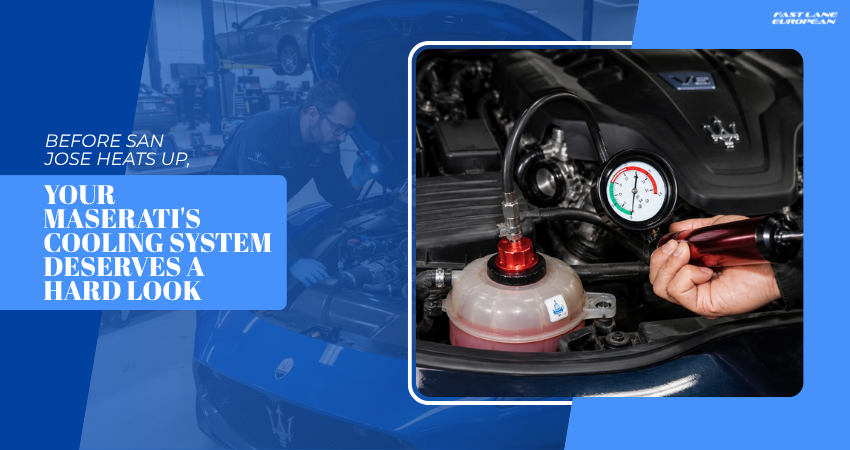
A Maserati is a thrill until the temperature needle starts climbing on Highway 17. These are Ferrari-engineered engines packed into tight bays, and they run hot by nature — so the cooling system has almost no margin for error when a San Jose summer arrives.
The parts that fail are rarely the big ones. It’s a $40 plastic fitting, a tired hose, a weak water pump. Ignore the early signs and a cheap part can cook a Ghibli or Levante engine into a repair that costs more than the car is worth. If yours is due, service the cooling system before the heat, not after it strands you.
Quick Summary: Key Takeaways
- Maseratis run hot by design: Ferrari-built twin-turbo V6s in a tight engine bay leave the cooling system little room for error.
- Plastic is the weak link: Coolant fittings, the expansion tank, and hoses go brittle and crack in heat first.
- Watch the needle on grades: Climbing the 17 toward the summit with the AC on is where a marginal system boils over.
- Don’t drive it hot: A cracked $40 fitting can become a warped head and a five-figure bill if you keep going.
- Service before summer: A pressure test and coolant service now is far cheaper than a tow off the highway.
A Maserati’s Cooling System Has No Margin in the Heat
These engines make their power with two turbos and a lot of underhood heat, and Maserati packs it all into a tight bay with limited airflow. Thrilling on Highway 85. Unforgiving in gridlock. The cooling system runs near its limit even on a cool, easy day, which leaves it nothing in reserve when the weather turns.
Add a 95-degree San Jose afternoon and the margin disappears. Gone. A system that’s 90 percent healthy will coast through a mild spring without a hint of trouble, then quit the very first time you really lean on it in the heat.
The Parts That Fail First Are Small and Cheap
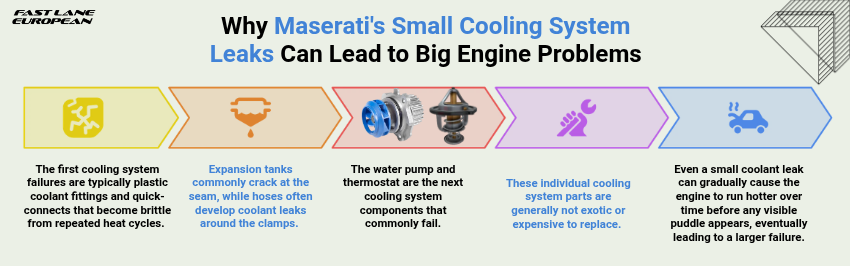
It’s almost never the radiator. On a Ghibli, Quattroporte, or Levante, the first failures are the plastic coolant fittings and quick-connects that go brittle with heat cycles, the expansion tank that cracks at a seam, and hoses that weep at the clamps. The water pump and thermostat follow.
None of that is exotic or expensive on its own. The danger is what a small leak leads to. Lose coolant slowly, drip by drip over weeks, and the engine will run hotter and hotter long before you ever see a puddle on the garage floor. Then it lets go.
Highway 17 and Summer Traffic Are Where It Shows Up
Cooling systems fail under load. Always. And nothing loads a Maserati like a long grade in July — climb the 17 toward the Santa Cruz summit on a hot afternoon with the AC blasting and the coolant temperature spikes right when the system is weakest, which is exactly the moment a marginal fitting or pump gives up and lets go.
Bumper-to-bumper on 101 or 280 does it too — no airflow, no relief. AAA expected to rescue 7.7 million drivers over the summer of 2025, and an overheated engine is one of the fastest ways to join them.
Limping an Overheating Maserati Home Is How Engines Die
Heat destroys aluminum engines. When coolant temps spike, heads warp and gaskets fail, and on a Maserati that’s no weekend job. A cracked fitting is a couple hundred dollars fixed today. Keep driving it hot, though, and you can warp the head, cook the gasket, and score the cylinder walls all at once — and now the number has five digits.
The move is simple. If the needle buries or you see steam, pull over, shut it off, and call for a tow. We would much rather see your car on a flatbed than on our lift with the head already off.
How We Service a Maserati Cooling System the Right Way
We start with a pressure test and a real diagnosis, not parts-cannon guessing. That shows whether you’re losing coolant at a fitting, a hose, the pump, or somewhere internal. From there we replace what actually failed, upgrade the weak plastic pieces where better parts exist, and refill with the correct Maserati coolant.
Exotic European cars are what we do. Owners across San Jose, Santa Clara, and Los Gatos trust us with the cars most shops won’t touch, and every qualifying repair carries our 24-month/24,000-mile warranty. Bring it in before summer. Then drive it, don’t baby it.

Frequently Asked Questions
Q: Why do Maseratis overheat in the summer?
A: Their Ferrari-built twin-turbo engines run hot and sit in a tight engine bay with limited airflow, so the cooling system operates near its limit. Summer heat and long grades push it over, and the first parts to fail are usually brittle plastic coolant fittings, the expansion tank, hoses, or the water pump.
Q: What are the signs my Maserati’s cooling system is failing?
A: Watch for the temperature needle drifting up in traffic or on hills, a sweet coolant smell, low coolant in the tank, or a small puddle under the front of the car. Catch these early and the fix is cheap; ignore them and overheating can damage the engine itself.
Q: Is it safe to drive a Maserati that’s running hot?
A: No. Driving an overheating Maserati risks warping the cylinder heads and blowing head gaskets, turning a minor coolant leak into a five-figure engine repair. If the gauge climbs into the red or you see steam, pull over, shut it down, and have it towed.
Q: How often should a Maserati cooling system be serviced?
A: Have it pressure-tested and the coolant condition checked at least once a year, ideally before summer, and replace coolant on the model’s schedule. Proactively replacing brittle plastic fittings and aging hoses is far cheaper than the engine damage a failure can cause.
Service Your Maserati’s Cooling System Before Summer Hits
Temperature creeping up in traffic? Get the cooling system pressure-tested before your next drive over the hill.
Fast Lane European — 3585 Stevens Creek Blvd, San Jose, CA 95117
Hours: Monday–Friday 8:30 AM – 5:30 PM; Saturday–Sunday closed
Website: fastlaneeuropean.com