 Mon – Fri: 8:30 AM – 5:30 PM
 3585 Stevens Creek Blvd, San Jose, CA 95117
 (408) 985-2000
 (408) 985-1000


 Make An Appointment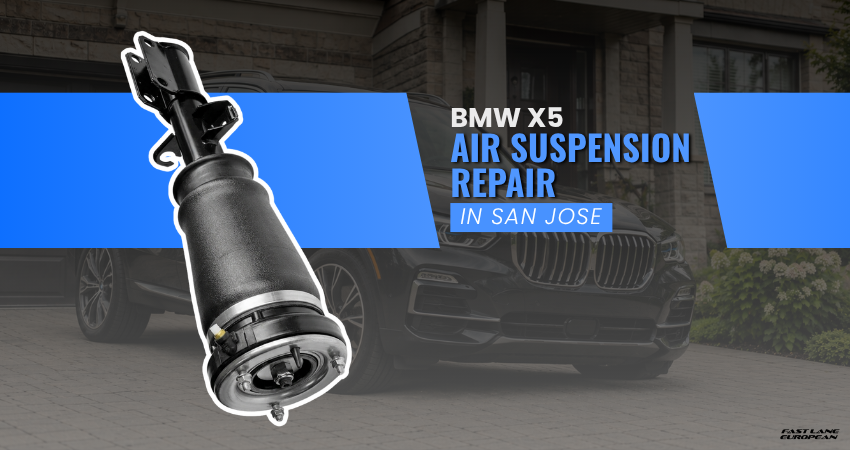
You walk out to the driveway and the back of your BMW X5 is sitting low over the rear wheels. Maybe the dash flashed ‘Suspension malfunction, drive moderately‘ on your way down Stevens Creek Blvd. That sag isn’t cosmetic. On an X5 with air suspension it means a leak somewhere in the system, and it rarely fixes itself. Something is leaking.
Air suspension repairs on a German SUV aren’t cheap, and putting them off usually costs more. AAA has found that about one in three U.S. drivers couldn’t cover an unexpected $500 to $600 repair without taking on debt, which is exactly the kind of bill a neglected air suspension turns into. Catch a leaking air spring early and you often save the compressor too.
Quick Summary: Key Takeaways
- Sagging overnight: A corner that drops after the car sits is the classic sign of a leaking air spring on the X5.
- Compressor at risk: One air spring leak makes the compressor run constantly, and that’s how a $1,200 job becomes a $2,000 one.
- Model matters: E70, F15, and G05 X5s use different air struts and valve blocks, so parts don’t carry over between them.
- Warning light: ‘Drive moderately’ means the system gave up leveling, so scan it before the compressor burns out.
- Set it to spec: A replacement air strut has to be brought up to the factory ride-height figure, or the X5 sits crooked and the sensors keep fighting it.
Air suspension keeps your X5 level, and one leak breaks it
Steel springs, gone. The X5 rides on rubber air bags that a compressor fills to hold ride height. On xDrive models BMW put self-leveling air springs on the rear axle, and the full two-axle setup was an option on the G05. It’s a closed loop. Air bags, a compressor, a valve block, ride-height sensors, and a control module all talk to each other, so when one air spring cracks the compressor keeps pumping to compensate, runs hot, and eventually quits, turning a single leak into a chain of failures.
Common signs point to the strut, the compressor, or a sensor
Most X5 air suspension problems show up in three ways. The rear or one corner sits low after the car is parked overnight, which is a leaking air spring, usually the rubber bladder splitting somewhere between 80,000 and 120,000 miles. Next comes the compressor. One that groans, runs long, or trips a fuse is usually the second failure to arrive. A ride that won’t level at all, plus a yellow suspension warning, means a bad height sensor or a pump that has given up. Listen for it. You’ll often hear the pump cycling far more than it should.
Leaks and worn compressors cause most of these failures
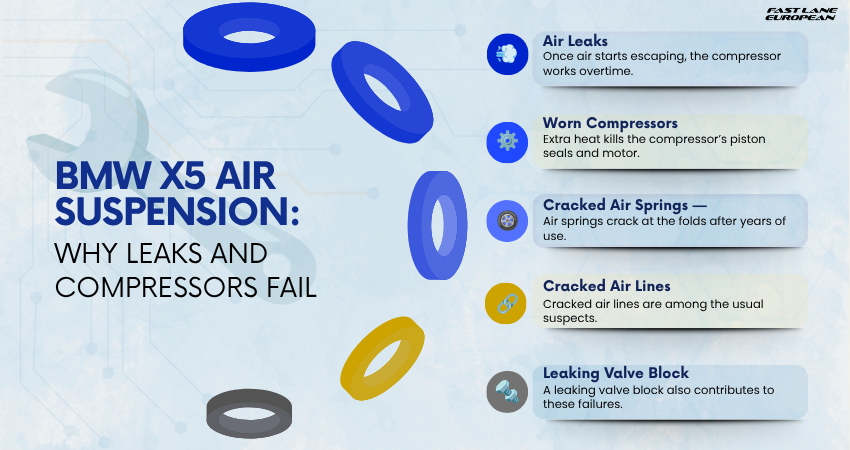
Age and California heat do most of the damage here. The rubber air springs flex thousands of times a day, and after a decade around San Jose they crack at the folds, with the rear bags on E70 and F15 X5s especially prone to it. Once air starts escaping, the compressor works overtime, and the extra heat kills its piston seals and motor. Salt isn’t the enemy out here. Time, ozone, and heat are. Cracked air lines and a leaking valve block round out the usual suspects.
Ignoring a small leak turns into a big repair bill
Here’s the stance: fix the leak early. One OEM rear air strut runs about $1,000 to $1,500 installed, and a replacement compressor is another $600 to $900. Let one leaking bag run the compressor into the ground and you pay for both at once, plus the labor to open the system twice. We see it monthly. An X5 owner waits, the pump dies on Highway 280, and the whole leveling system fails, so a repair that could have been simple turns into a much larger one. Doing it in a single visit is cheaper and safer. Pay once, not twice.
How our San Jose shop diagnoses and repairs the system
We start with a full scan, not a parts swap. Our techs pull the fault codes with BMW-capable diagnostics, pressure-test the system to find the actual leak, and check the compressor’s current draw before quoting anything, because a guess on air suspension gets expensive fast. If a strut needs replacing, we fit the correct OEM part for your E70, F15, or G05 and set the ride height back to the factory figure before the car leaves. One visit. We’ve done this since 2011 and back the work with a 24-month/24,000-mile warranty.
Frequently Asked Questions
Q: Why is my BMW X5 sagging on one side?
A: Sag on one corner overnight almost always means a leaking air spring on that side. The rubber bladder has cracked and can’t hold pressure. Get it checked before the compressor overworks itself trying to keep the car level.
Q: Can I replace X5 air suspension with regular coil springs?
A: Coil-conversion kits exist. They disable the self-leveling system, though, and often trigger dash warnings. On an X5 we recommend repairing the factory air setup so ride height, handling, and the electronics all work as designed.
Q: How long do BMW X5 air struts last?
A: Most original air springs start failing between 80,000 and 120,000 miles as heat and age crack the rubber. If yours is past 80k and sagging, plan on service soon rather than waiting for the compressor to fail too.
Get your X5 suspension checked before the compressor fails
Noticing a sag or a suspension warning around San Jose, Santa Clara, or Los Gatos? Bring your X5 in for a proper diagnosis and a straight quote. Book online. We’ll get it sitting level again.
Website: fastlaneeuropean.com