 Mon – Fri: 8:30 AM – 5:30 PM
 3585 Stevens Creek Blvd, San Jose, CA 95117
 (408) 985-2000
 (408) 985-1000


 Make An Appointment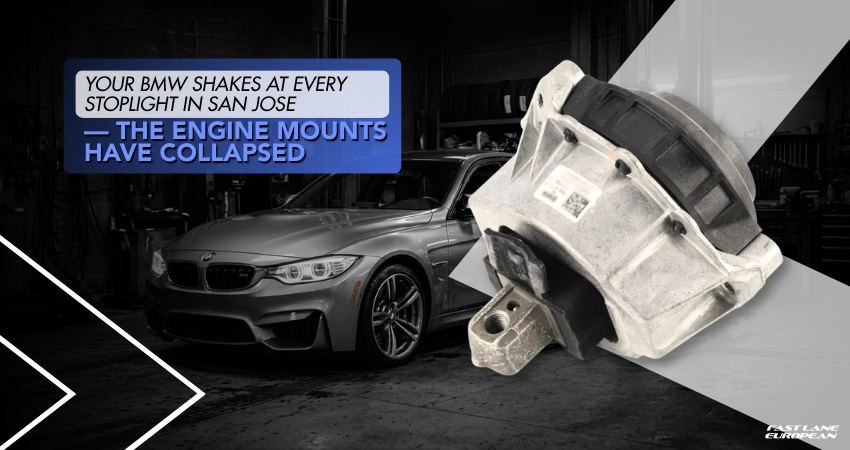
You stop at the light on Stevens Creek Boulevard and the whole car buzzes. Steering wheel, seat, gear selector. Then you pull away and it smooths out like nothing happened. That pattern — bad at idle, fine at speed — is the signature of collapsed hydraulic engine mounts, and it’s one of the most common complaints we hear from San Jose owners of BMW, Audi, Porsche and Mercedes.
Mounts are not glamorous. They’re also not optional. A mount that has torn or bled out its fluid stops isolating the engine and starts letting it move, and everything bolted to that engine — hoses, lines, the exhaust hangers, the transmission mount behind it — begins paying the price.
Quick Summary: Key Takeaways
- The tell is idle-only vibration: a shake you feel at a stop that disappears once the car is moving points at mounts, not at the engine itself.
- European mounts are hydraulic: they contain fluid, so they don’t just crack like rubber — they leak, then collapse and sag.
- Height matters: a collapsed mount lets the engine sit lower, which loads axles, hoses and the exhaust in ways they were never designed for.
- A clunk on acceleration is late-stage: by then the engine is moving far enough to hit its travel limits.
- They wear in pairs: replacing one side of a 100,000-mile car and leaving the other is false economy.
Hydraulic mounts fail differently from plain rubber ones
Most European engines sit on fluid-filled mounts. Inside each one is a chamber of oil that damps engine vibration far better than solid rubber ever could.
That design is why a BMW idles like it’s switched off when the mounts are healthy. It’s also why they fail the way they do: the rubber bladder splits, the fluid weeps out down the side of the mount, and what’s left is a soft, sagging lump with no damping left. You can often see the residue. Look for a dark, oily film on the mount body and the subframe under it.
Rubber cracks. Hydraulic mounts bleed.
The symptoms follow a predictable order
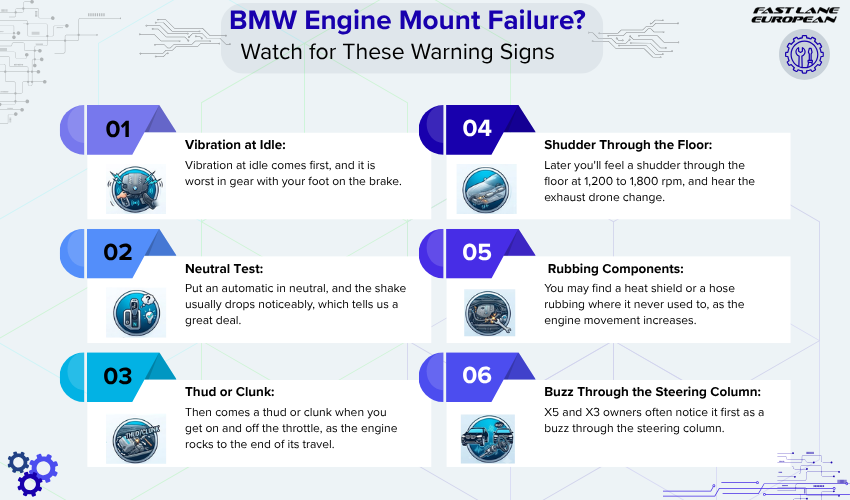
Vibration at idle comes first, and it is worst in gear with your foot on the brake. Put an automatic in neutral and the shake usually drops noticeably — that single test tells us a great deal.
Then comes a thud or clunk when you get on and off the throttle, because the engine is now rocking far enough to reach the end of its travel. Later still you’ll feel a shudder through the floor at 1,200 to 1,800 rpm, hear the exhaust drone change, and possibly find a heat shield or a hose rubbing where it never used to. X5 and X3 owners often notice it first as a buzz through the steering column.
Stop-and-go traffic is what wears them out here
Mount life is measured in cycles, not just miles. Every start, every stop, every gear engagement flexes that rubber, and Santa Clara County traffic delivers a lot of cycles per mile.
Add years of heat under the hood and the rubber hardens from the inside. AAA fielded more than 27 million roadside assistance calls in 2024, and about 13 million of those ended in a tow, per AAA’s 2025 car care release. Mounts rarely leave you stranded on their own. What they do is quietly break the parts that will.
A sagging engine damages more than your comfort
This is the part owners underestimate. A collapsed mount doesn’t just shake — it changes where the engine sits, and every flexible connection to it gets stretched or compressed out of position.
On a transverse layout, that means driveshaft angles go wrong and inner CV boots wear early. Coolant hoses chafe against brackets. The exhaust flex joint takes a load it wasn’t built for and eventually cracks, and a torn engine mount on a Porsche or a Mercedes will often show up first as an unrelated-looking leak somewhere downstream. Fix the mount and the mystery noises tend to leave with it.
How we confirm mounts before we sell you any
We don’t diagnose mounts by feel from the driver’s seat. We load them.
On the lift, we watch each mount under controlled engine torque, measure how far the engine actually lifts and drops, then check for fluid residue and for contact marks on nearby brackets — because a mount that looks intact can still be dead inside. We also check the transmission mount and the torque strut in the same visit, since a shake blamed on the engine mounts is sometimes coming from behind them. Then we show you what we found.
Fast Lane European has worked on these cars since 2011
We opened in 2011 and we’ve stayed a European specialist ever since — Audi, BMW, Jaguar, Land Rover, Maserati, Mercedes, MINI, Porsche, Volkswagen and Volvo.
Our work carries a 24-month, 24,000-mile warranty. Drivers come to us from Campbell, Los Gatos, Santa Clara and Cupertino, usually because someone told them we explain the repair instead of just quoting it. Mounts are a good example. Once you’ve seen the old one flop in your hand, the diagnosis makes sense.
Frequently Asked Questions
Q: Why does my car vibrate at idle but not while driving?
A: Because worn engine mounts stop absorbing the engine’s natural shake, and that shake is most noticeable at low rpm with the car stationary. Road speed masks it. If the vibration returns every time you stop, have the mounts loaded and inspected.
Q: How long do BMW and Audi engine mounts last?
A: Most hydraulic mounts we replace have between 80,000 and 120,000 miles on them, though heavy stop-and-go use and underhood heat shorten that. Age alone degrades the rubber, so a low-mileage older car isn’t exempt.
Q: Is it safe to drive with a broken engine mount?
A: For a short trip, usually. Long-term, no. Excess engine movement damages hoses, axles and exhaust components, and a fully separated mount lets the engine contact things it shouldn’t. Get it inspected rather than living with the shake.
Q: Should both engine mounts be replaced at once?
A: On a car past 100,000 miles, yes. They aged together and they’re accessed together, so doing one and returning for the other costs you more in labor than doing the pair now.
Book an engine mount inspection in San Jose
If your European car buzzes at every red light this autumn, it isn’t something you have to live with. Bring it in and we’ll load the mounts and show you the movement.
Website: fastlaneeuropean.com