 Mon – Fri: 8:30 AM – 5:30 PM
 3585 Stevens Creek Blvd, San Jose, CA 95117
 (408) 985-2000
 (408) 985-1000



 Make An Appointment
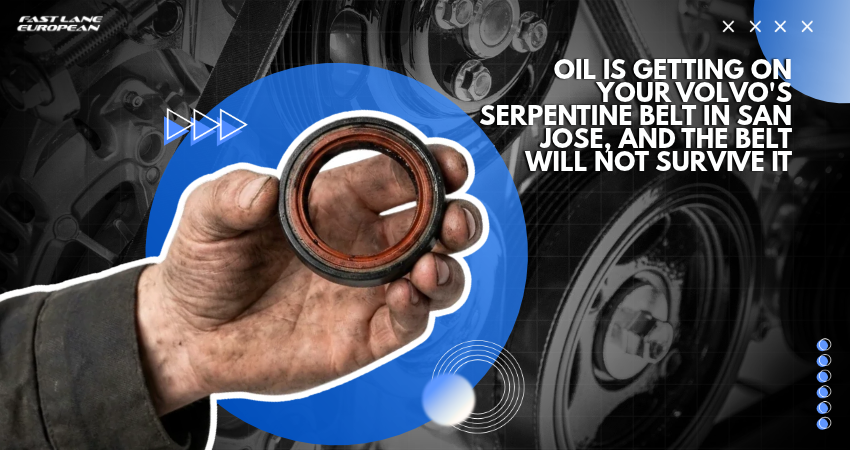
A squeal that only shows up on cold mornings and fades after a few minutes reads like a worn belt. On a Volvo, it is often engine oil, thrown off the crankshaft pulley in a fine mist that coats the ribs, the tensioner and most of the lower timing cover. Fit a new belt and it lasts about as long as the first one did.
That is the pattern of a front crankshaft seal. It rarely announces itself as a leak. It announces itself as a noise, and the noise is the belt losing its grip on rubber that has been swelling for months.
The seal sits where the oil can do the most damage
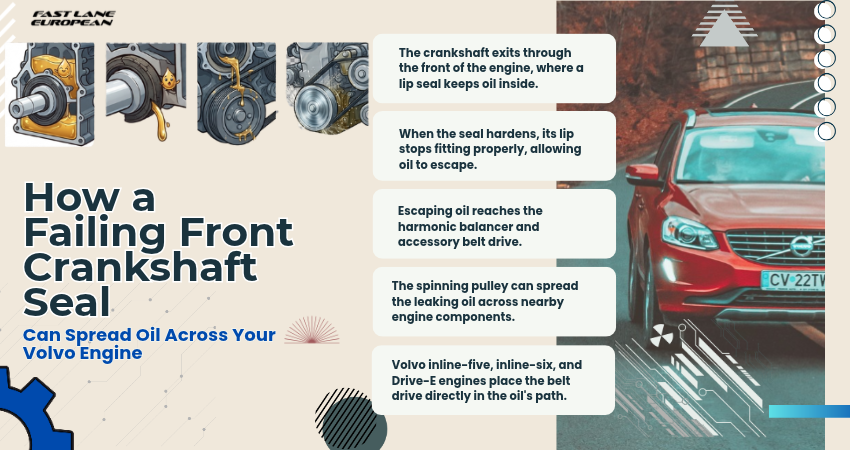
The crankshaft comes out through the front of the engine, and a lip seal rides on that snout to keep oil inside. Directly outboard of it sits the harmonic balancer and the accessory belt drive. When the seal hardens and the lip stops conforming, oil escapes into exactly the one place on the engine where a spinning pulley will atomize it and spray it across everything nearby.
Volvo’s inline fives and sixes, and the four-cylinder Drive-E engines after them, all place the belt drive directly in that line of fire. So does nearly every other transverse-engine layout, so the symptom is familiar across the European lineup and is not a Volvo quirk.
Rubber and oil are a bad combination
The ribs on a serpentine belt work by friction against the pulley grooves. Oil defeats that twice. It lubricates the contact patch, so the belt slips under load and squeals when the alternator or another accessory asks for torque. It also soaks into the rubber compound, which swells, softens, and begins to shed the cords that hold it together.
A swollen belt also stops tracking straight. It walks sideways in the grooves, frays along one edge, and chews at the tensioner pulley bearing while it does it.
What the failure actually looks like from the driver’s seat
For months there is no symptom at all, and then there is every symptom at once. The belt drives the alternator, and on many of these engines it drives the water pump and the power steering pump as well. When it comes apart the battery light appears and charging stops, and where the water pump runs off that belt the temperature needle starts climbing within a mile or two. Most drivers get a short warning and a long walk.
Where that happens matters. In an October 2026 release on roadside safety, AAA reported that more than 2,100 people were struck and killed while stranded or working on the roadside between 2019 and 2023. A belt that was already glazed and oil-soaked at the last service is an avoidable version of that.
How to spot it before the noise starts
Open the hood with the engine off and look at the bottom of the belt run, down near the crank pulley. Fresh oil at the front of the engine is dark and still wet. Older contamination shows as a black, greasy film on the inside face of the belt and a crust of oily dust on the tensioner arm.
Two other signs are worth knowing. A thin line of oil thrown onto the inner fender or the undertray on the passenger side points at the pulley slinging it. And a belt that has started to swell will often sit a fraction proud of the pulley grooves instead of seated down in them.
The repair is cheap early and awkward late
Replacing the front main seal means removing the belt and the crankshaft pulley, and on some engines the lower timing cover too. The seal itself is a small part and the labor is the shorter half of the job at that stage. Done then, the belt and tensioner go back on clean and the work ends there.
Leave it a year and the list grows. The belt is scrap, the tensioner bearing is usually noisy, the idler pulleys have been running in oil mist, and the crankshaft snout can wear a groove where the seal lip rides, which means the new seal needs a repair sleeve to have anything smooth to seal against.
December in the South Bay is when it shows up
Cool, damp mornings are the condition that makes an oil-glazed belt squeal, because a cold belt is stiffer and a wet one has even less grip. Rain also washes the undertray, so the evidence you might have spotted on a dry month gets rinsed away before you look.
If your Volvo has started chirping for the first minute of a drive and quieting down afterward, that is not the belt asking to be replaced. It is the belt reporting what is dripping onto it.
A Ten-Minute Look at the Front of the Engine
The undertray comes off, the crank seal and the belt get inspected together, and you find out whether this is a seal, a belt, or both before one of them strands you on the 280.
Fast Lane European — 3585 Stevens Creek Blvd, San Jose, CA 95117